Why Gulf Industries Are Switching to Closed Circuit Cooling Towers
In the arid Gulf climate where water is scarce and temperatures exceed 45C, Closed Circuit Cooling Towers deliver 18-24 month ROI through water and energy savings.
Why are Gulf industries switching to CCCTs?
Gulf industries are switching to Closed Circuit Cooling Towers because they deliver 30-40% water savings, 25% energy reduction, and 18-24 month ROI payback. The sealed design also protects against sandstorms and aligns with UAE Vision 2030 sustainability goals.
Why this shift matters in the Gulf
In the arid Gulf climate, where water is scarce and ambient temperatures soar above 45C, cooling efficiency is not a luxury — it's a necessity. More and more industries in the UAE, Saudi Arabia, Oman, and Qatar are transitioning to Closed Circuit Cooling Towers (CCCTs) as their preferred cooling solution.
This blog explores the key drivers behind this shift, the real-world advantages of CCCTs, and how Harrison Cooling Towers is leading this transformation across the Gulf.
Gulf-Specific Challenges in Industrial Cooling
- Extreme Ambient Temperatures – Summer heat exceeds 50C in many Gulf regions
- Dust, Sand, and Airborne Contaminants – Frequent sandstorms damage equipment
- Water Restrictions and Regulations – Municipal limits on industrial water usage
- Energy Cost Sensitivity – High electricity tariffs demand efficiency
Open cooling systems struggle in such conditions, leading to high water blowdown, coil fouling, frequent downtime, and expensive chemical treatment.
Why Closed Circuit Cooling Towers Are the Future
CCCTs offer a sealed heat exchange system that protects internal fluid from exposure, ensuring:
- No airborne contamination – Sealed coils keep process fluid clean
- Drastic reduction in water usage – Closed loop minimizes evaporation
- Lower chemical treatment costs – Reduced scaling and biological growth
- Higher energy efficiency – Optimized heat transfer surfaces
- Reduced Legionella risk – Closed loop design minimizes bacteria growth
Harrison's Engineering Edge
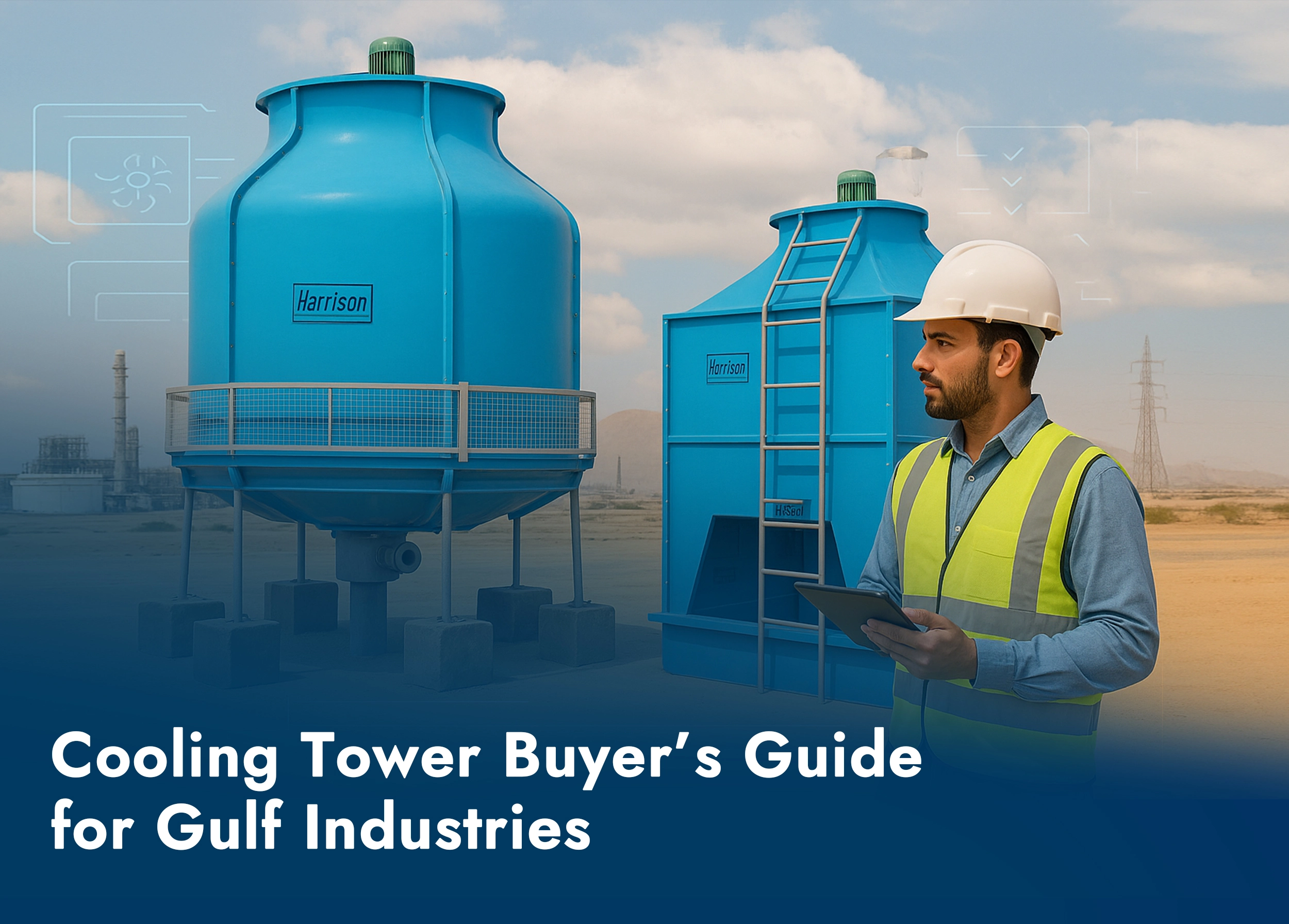
Harrison Cooling Towers offers Gulf-hardened designs specifically engineered for desert conditions:
- UV-stable FRP casings – Resists sun degradation and salt spray
- Corrosion-resistant coils – SS316 or copper for longevity
- Low RPM, High-Efficiency Fans – Designed for sandy environments
- Drift Eliminators & Water Management Systems – Comply with municipal water norms
- On-Ground Service Support – Teams across UAE, Saudi Arabia & Oman
- Pre-sales Consultation & On-site Surveys – Custom engineering for every project
Return on Investment for Gulf Industries
While the initial cost of a CCCT may be higher than open circuit models, Gulf industries are seeing ROI within 18-24 months due to:
- 30-40% Water savings annually – Critical in water-scarce regions
- 25% Energy cost reductions – VFD fans and optimized operation
- 50% fewer shutdowns for cleaning – Reduced maintenance downtime
- Up to 5 years added to equipment life – Protected process fluids and coils
Ideal Use Cases in the Gulf
- Petrochemical Facilities – Jubail, Abu Dhabi, Sohar
- Data Centers – Dubai Internet City, Muscat IT Park
- HVAC in Luxury Hotels & Malls – Riyadh, Doha, Jeddah
- Manufacturing Hubs – Al Ain, Ras Al Khaimah, Bahrain
Frequently Asked Questions
What ROI can Gulf industries expect from switching to CCCTs?
18-24 month payback through 30-40% water savings and 25% energy savings compared to open circuit systems.
How do CCCTs handle Gulf sandstorms?
The sealed coil design prevents sand and dust from contaminating process fluid, maintaining clean heat transfer surfaces even during sandstorms.
Are CCCTs compliant with Gulf environmental regulations?
Yes, CCCTs reduce water usage and align with UAE Vision 2030 and Saudi Vision 2030 sustainability goals for industrial facilities.
What GCC regions does Harrison serve?
Harrison has technical teams and installations across UAE, Saudi Arabia, Oman, Qatar, Kuwait, and Bahrain.
CCCTs are the future-ready cooling solution for the Gulf.
With water scarcity, regulatory pressure, and operational costs rising in the Gulf, Closed Circuit Cooling Towers are not just the best choice — they're the only future-ready solution. Harrison Cooling Towers offers turnkey Gulf-ready CCCT solutions from design to maintenance.