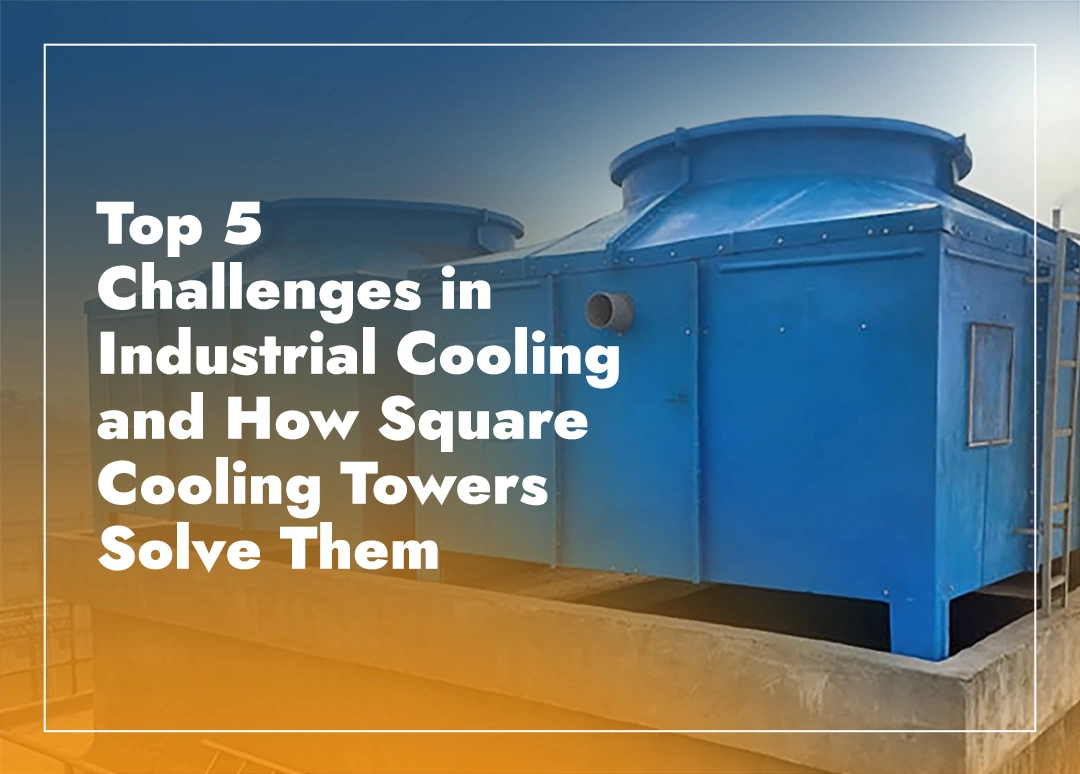
Top 5 Challenges in Industrial Cooling and How Square Cooling Towers Solve Them
Practical solutions to the most common industrial cooling challenges, with square cooling tower technologies that address heat dissipation, water conservation, corrosion, energy efficiency, and maintenance.
How do square towers solve industrial cooling challenges?
Square cooling towers address the five key industrial cooling challenges through optimized counterflow heat exchange, advanced drift elimination for water conservation, FRP construction for corrosion resistance, VFD-compatible fans for energy efficiency, and modular designs with easy maintenance access.
Why industrial cooling presents unique challenges
Industrial cooling systems face a unique set of challenges that differ significantly from commercial or residential applications. Facilities must maintain precise temperature control for critical processes while managing costs, water consumption, and equipment longevity in demanding environmental conditions.
In regions like the Middle East and South Africa, these challenges are amplified by extreme ambient temperatures, high humidity in coastal areas, saline air exposure, and water scarcity. Industrial facilities in these regions need cooling solutions specifically engineered to overcome these environmental hurdles.
Square cooling towers have emerged as the preferred solution for addressing these challenges. Their advanced engineering provides superior performance across all five critical areas: heat dissipation efficiency, water usage management, corrosion and scaling resistance, energy consumption, and maintenance requirements.
This article examines each of these challenges in detail and explains how Harrison Cooling Towers' square cooling tower designs provide effective solutions for industrial facilities in demanding climates.
Challenge: Heat Dissipation Efficiency
The primary function of any cooling tower is to reject heat efficiently. However, achieving consistent, high-efficiency heat dissipation in industrial applications presents several technical challenges, particularly in high-ambient-temperature environments.
The challenges include:
- High ambient temperatures: Gulf summer temperatures exceeding 45°C reduce the temperature differential between hot water and ambient air, making heat rejection more difficult
- Variable thermal loads: Industrial processes often produce fluctuating heat loads that require cooling systems to respond quickly
- Non-uniform water distribution: Uneven water flow across fill media creates hot spots and reduces overall efficiency
- Airflow short-circuiting: Poor air distribution can cause recirculation of warm exhaust air back into the intake
How square cooling towers solve this:
- Counterflow design: Optimizes air-to-water contact for maximum heat transfer even at high ambient temperatures
- Uniform water distribution: Precision spray nozzle systems ensure even water coverage across the entire fill surface
- Optimized airflow: Scientifically designed air inlet geometry prevents short-circuiting and ensures fresh air utilization
- High-performance fills: Advanced fill media configurations maximize surface area for efficient evaporation
Challenge: Water Usage Management
Water is a precious resource, especially in arid regions. Industrial cooling towers consume significant water volumes through evaporation, drift, and blowdown. Managing water consumption is both an environmental responsibility and an economic imperative.
The challenges include:
- High evaporation rates: The very mechanism that makes cooling towers effective also consumes substantial water volumes
- Drift loss: Water droplets carried away by exhaust air represent direct water loss
- Scaling and fouling: Mineral buildup reduces heat transfer efficiency, requiring more water for the same cooling effect
- Microbial growth: Warm, wet environments promote bacteria including Legionella, requiring water treatment and blowdown
How square cooling towers solve this:
- Advanced drift eliminators: Multi-pass elimination systems reduce drift loss to below 0.001%, significantly reducing water consumption
- Optimized fill design: Scientifically designed fills maximize heat transfer while minimizing water usage
- Water treatment integration: Compatible with various water treatment systems to maximize cycles of concentration and reduce blowdown
- Basin design: Optimized collection basins minimize overflow, splashing, and windage losses
Challenge: Corrosion and Scaling
Cooling towers operate in harsh conditions that accelerate material degradation. Corrosion and scaling compromise equipment integrity, reduce efficiency, and lead to premature failure if not properly addressed.
The challenges include:
- Saline air exposure: Coastal installations face constant exposure to salt-laden air that accelerates metal corrosion
- Chemical exposure: Process cooling applications may involve chemically aggressive water conditions
- UV degradation: Continuous sun exposure breaks down conventional materials
- Scale formation: Hard water causes mineral scale buildup on heat transfer surfaces
How square cooling towers solve this:
- FRP construction: Fiber Reinforced Plastic casings are inherently corrosion-resistant and UV-stable
- High-quality coatings: Premium powder coatings on structural steel provide long-lasting corrosion protection
- SS316 hardware: Critical fasteners and components in marine-grade stainless steel resist salt air
- Anti-scale technologies: Design features that minimize scale accumulation and simplify cleaning
Challenge: High Energy Consumption
Cooling towers are typically the largest energy consumers in industrial facility cooling systems. Fan motors, water pumps, and auxiliary equipment contribute significantly to operational costs.
The challenges include:
- Continuous fan operation: Large fan motors running continuously represent substantial electricity consumption
- Fixed-speed fans: Traditional towers cannot adjust airflow to match varying cooling demands
- Inefficient components: Suboptimal fan blade designs and motor efficiencies waste energy
- Limited part-load efficiency: Performance suffers when operating below design capacity
How square cooling towers solve this:
- VFD-compatible fans: Variable frequency drives allow precise fan speed control to match cooling demand
- Energy-efficient motors: IE3 premium efficiency motors minimize electricity consumption
- Optimized airflow: Aerodynamically designed fan blades and air paths reduce energy requirements
- Part-load performance: Advanced designs maintain efficiency across a wide operating range
Challenge: Maintenance and Downtime
Unplanned downtime is extremely costly in industrial facilities. Cooling tower maintenance must be efficient and thorough while minimizing disruption to operations.
The challenges include:
- Accessibility: Poor access makes inspection and maintenance difficult and time-consuming
- Component replacement: Difficult-to-reach components extend maintenance time and labor costs
- Cleaning difficulty: Scale, algae, and debris accumulation requires frequent cleaning
- Limited support: In remote locations, obtaining expert maintenance support can be challenging
How square cooling towers solve this:
- Easy access design: Wide access doors and internal platforms enable thorough inspection and maintenance
- Modular construction: Individual modules can be serviced without shutting down the entire system
- Durable components: Long-lasting fills, nozzles, and drift eliminators reduce maintenance frequency
- 24/7 expert support: Harrison's technical teams across the Middle East and South Africa provide responsive maintenance and emergency repair services
Frequently Asked Questions
How do square cooling towers improve heat dissipation efficiency?
Square cooling towers utilize counterflow heat exchange with uniform air distribution and optimized water flow patterns. Precision spray nozzles ensure even water coverage across high-performance fill media, while scientifically designed airflow paths maximize heat rejection even in high ambient temperatures.
What features reduce water usage in Harrison's square cooling towers?
Harrison's towers feature scientifically designed multi-pass drift eliminators that reduce water loss to below 0.001%. Advanced fill designs maximize heat transfer efficiency while minimizing evaporation requirements, and basin designs reduce windage and overflow losses.
How do Harrison's towers prevent corrosion in harsh climates?
Harrison uses FRP (Fiber Reinforced Plastic) construction for tower casings, providing inherent corrosion resistance and UV stability. Structural steel receives premium powder coating, and critical hardware uses marine-grade SS316 stainless steel to withstand saline coastal air and chemical exposure.
What maintenance support does Harrison offer?
Harrison provides 24/7 expert support teams across the Middle East and South Africa, including preventive maintenance programs, emergency repairs, and readily available genuine spare parts. Our regional presence ensures rapid response when you need it most.
Square Cooling Towers: The Complete Industrial Cooling Solution
Industrial facilities facing cooling challenges in demanding environments can rely on square cooling tower technology to address heat dissipation, water conservation, corrosion resistance, energy efficiency, and maintenance requirements. Harrison Cooling Towers combines proven engineering with regional expertise to deliver solutions that perform reliably in Middle East and African conditions.